Updated August 2026: I’ve been monitoring the evolving landscape of trauma and unhealthy relationships, and I’m excited to share some significant developments from 2024 to 2025. One notable trend I’ve observed is the increasing integration of trauma-informed care into relationship counseling practices. More therapists are now adopting holistic approaches that acknowledge how past traumas influence current relational dynamics, fostering healthier interactions. Additionally, there has been a surge in online support groups, particularly on social media platforms, where individuals share their experiences and coping strategies in real-time, creating a robust community that offers validation and support. In my recent research, I’ve updated my understanding of how technology is shaping our perceptions of relationships and trauma. Virtual reality therapy has emerged as an innovative tool to help individuals confront and process their trauma in a controlled environment, leading to promising outcomes in emotional regulation and relationship building. Furthermore, I’ve noted an increased awareness around the importance of consent and boundary-setting, particularly in the context of digital interactions, which has become a crucial part of discussions in workshops and seminars. These developments are vital in addressing the complexities of trauma and unhealthy relationships, and I’m committed to keeping this information current as new insights emerge.
Table of Contents
If you’ve ever found yourself in the same type of relationship over and over again—emotionally unavailable partners, controlling dynamics, or cycles of hurt—you may have asked yourself: “Why does this keep happening to me?”
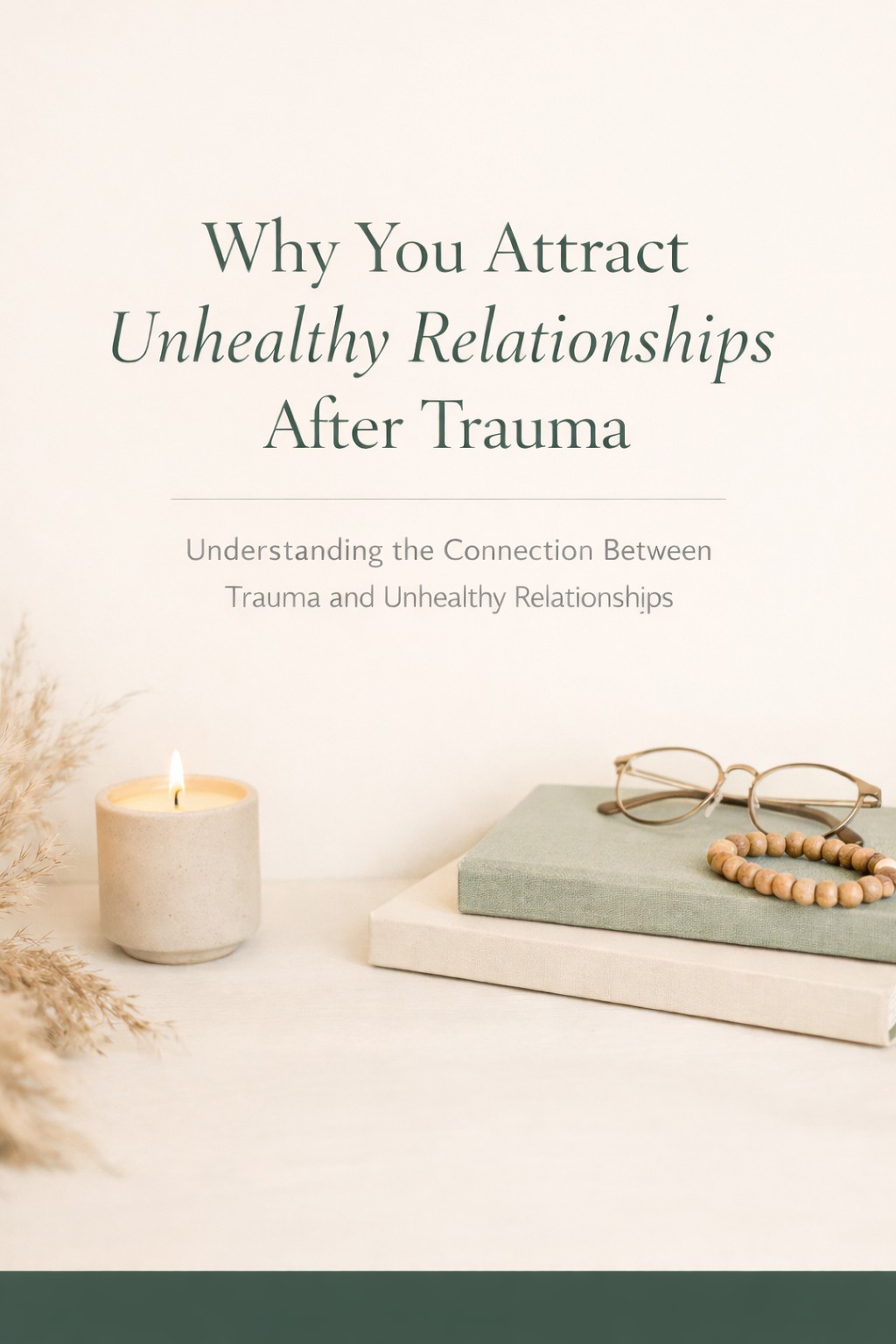
Understanding trauma and unhealthy relationships can be a powerful turning point in your healing journey. What you’re experiencing is not a personal failure—it’s often the result of how trauma shapes your nervous system, attachment patterns, and sense of safety.
When trauma is left unprocessed, it doesn’t just stay in the past. It shows up in the relationships you choose, the behaviors you tolerate, and the way your body responds to connection.
Why Trauma Changes Relationship Patterns
Trauma—especially from experiences like domestic violence, emotional abuse, or neglect—can deeply impact how you relate to others.
When your nervous system has learned that love comes with pain, unpredictability, or fear, it begins to adapt. These adaptations are not conscious choices—they are protective survival responses.
You may notice patterns like:
- Feeling drawn to emotionally unavailable or inconsistent partners
- Struggling to trust “healthy” or stable people
- Over-giving, people-pleasing, or ignoring red flags
- Feeling anxious, overwhelmed, or hypervigilant in relationships
This is because trauma wires your brain to prioritize familiarity over safety. Your body is trying to protect you based on what it has learned—even if those patterns are no longer serving you.
If you’re noticing these cycles, you may also relate to how trauma impacts emotional sensitivity. (You can read more about this in my post on why trauma makes you feel too sensitive.)
The Difference Between Familiar and Safe
One of the most important concepts in understanding trauma and unhealthy relationships is this:
Familiar does not equal safe.
After trauma, your nervous system often associates chaos, intensity, or emotional highs and lows with connection. So when you meet someone who feels calm, consistent, and emotionally available, it can actually feel… uncomfortable.
On the other hand, someone who triggers anxiety, uncertainty, or emotional intensity may feel exciting or magnetic—because it mirrors what your body already knows.
This can create a confusing internal experience:
- Healthy love may feel boring, slow, or “off”
- Unhealthy dynamics may feel passionate or hard to walk away from
This isn’t because you want unhealthy relationships—it’s because your nervous system is trying to return to what feels familiar.
Healing involves gently retraining your body to recognize that safety can feel calm, steady, and predictable.
Trauma Bonding Explained
Another key piece of trauma and unhealthy relationships is something called trauma bonding.
Trauma bonding happens when a strong emotional attachment forms through cycles of:
- Intense connection or affection
- Followed by hurt, withdrawal, or abuse
- Then repair, apologies, or “good moments”
This cycle creates a powerful emotional loop that can be incredibly hard to break.
Your brain becomes conditioned to seek the “high” after the low, and over time, the bond can feel addictive.
You might notice:
- Difficulty leaving even when you know the relationship is unhealthy
- Justifying or minimizing harmful behavior
- Feeling emotionally dependent on the other person
- Hoping things will go back to how they were in the beginning
Trauma bonds are not about weakness—they are rooted in both emotional attachment and nervous system conditioning.
If you’re working through this, learning skills like boundary-setting and emotional detachment (such as gray rocking) can be helpful. For additional education on trauma bonding and relationship dynamics, resources like National Domestic Violence Hotline provide valuable support and guidance.
How Therapy Helps You Rebuild Healthy Relationships
The good news is this: patterns related to trauma and unhealthy relationships can be changed.
Healing doesn’t mean blaming yourself—it means understanding what your nervous system learned and giving it new experiences of safety.
Trauma-informed therapy can help you:
- Identify and break repeating relationship patterns
- Process past trauma so it no longer drives present choices
- Regulate your nervous system and reduce emotional reactivity
- Build secure attachment and healthy boundaries
- Learn to recognize red flags and green flags
Approaches like EMDR, CBT, and somatic-based therapies can be especially effective in helping your brain and body shift out of survival mode.
Over time, what once felt unfamiliar—like consistency, respect, and emotional safety—can begin to feel natural.
You’re Not “Choosing Wrong”—Your Nervous System Is Trying to Protect You
If you’ve been caught in cycles of unhealthy relationships, it’s easy to turn that inward and believe something is wrong with you.
But the truth is:
You adapted to survive.
Your patterns make sense in the context of your experiences—but they don’t have to define your future.
As you begin to understand the connection between trauma and unhealthy relationships, you can start to make different choices—not from fear or familiarity, but from a place of safety, clarity, and self-trust.
Healing is possible. Starting trauma therapy can help you learn how to have healthy, secure love.